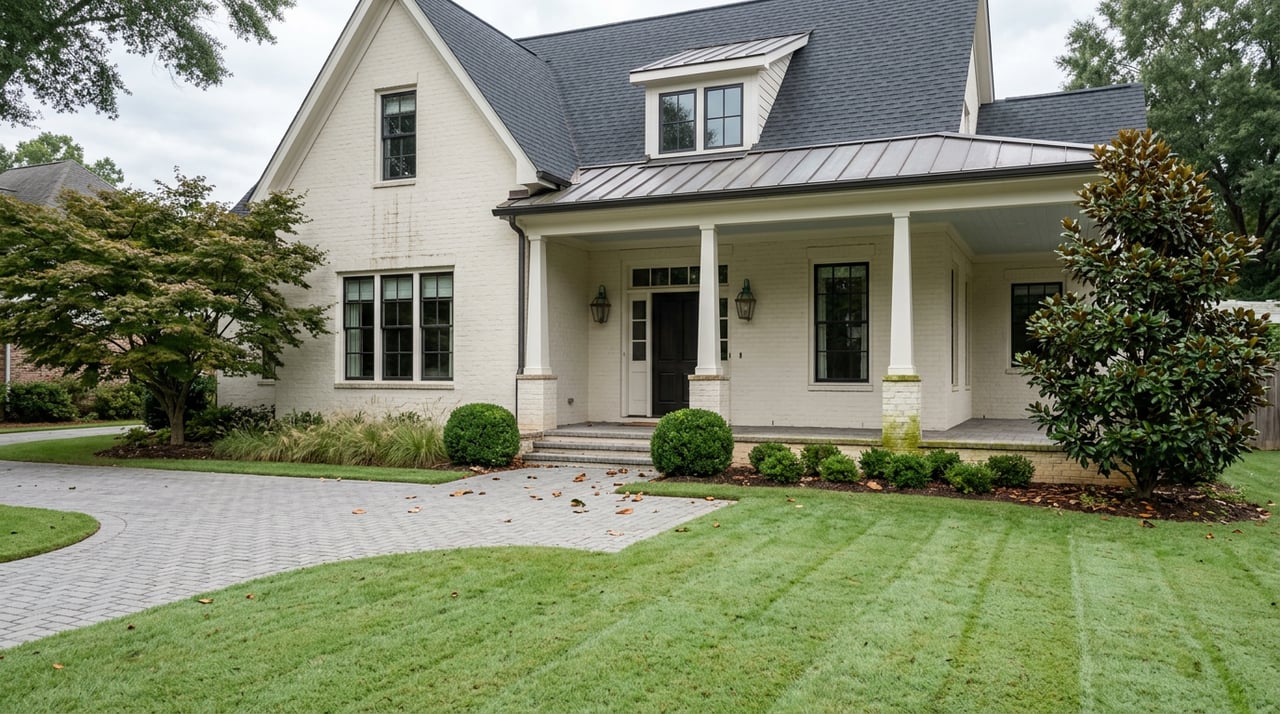
A couple buying a 1920s house in Germantown thought their pre-purchase inspection had covered the things that matter: roof, panel, fixtures, furnace. Then the report flagged something easy to skim past, a note about possible sewer issues buried among a page of minor items. They paid $295 to run a camera down the line before closing. It found clay pipe cracked in multiple places from tree roots. Their choice came down to $7,200 for trenchless lining or more than $15,000 to excavate the yard. They chose trenchless, the job took two days, and they never lost a single tree.
That story belongs to one house, but the math behind it belongs to a large share of the housing stock in Nashville's oldest walkable neighborhoods. In Sylvan Park, 12 South, East Nashville, and Germantown, the standard home inspection stops at the foundation. It looks at fixtures, water pressure, and visible plumbing inside the walls. It does not look at what's happening ten feet underground, where the pipe that carries every drop of wastewater out of the house sits waiting to either hold or fail. A buyer who skips that second look isn't buying a clean bill of health. They're buying an unknown.
Three Pipe Materials, Three Different Clocks
Nashville's inner bungalow neighborhoods were built across several decades, and each decade left behind a different pipe material with its own failure timeline.
| Material | Common era | Typical lifespan | How it fails |
|---|---|---|---|
| Clay | Before the 1960s | 50 to 60 years | Cracks as ground shifts, then invites root intrusion through the crack |
| Cast iron | Before the 1960s | 60 to 70 years | Corrodes from the inside, eventually leaking along the pipe bottom |
| Orangeburg (tar and wood pulp) | Mid-century, postwar | Variable, often decades | Slowly deforms and collapses inward with no visible surface warning |
None of these materials were built to last a century, and none of them announce trouble the way a leaking faucet does. Clay cracks quietly. Cast iron thins from the inside where nobody can see it. Orangeburg is the strangest of the three: it can look completely fine on a video feed right up until it caves in, because it fails by slowly losing its round shape rather than by springing a visible leak. A pipe installed in 1965, near the end of a typical clay or cast-iron lifespan, is reaching the far edge of that window right now.
Why the Math Lands Hardest Here
Sylvan Park, 12 South, and East Nashville share two things that make this a bigger deal than it would be in a newer subdivision. The first is age. Many of the homes in these neighborhoods date to the 1920s through the 1950s, squarely inside the window where clay, cast iron, and Orangeburg were standard. The second is the tree canopy that makes these streets so appealing to walk down in the first place. Mature oaks and maples send roots searching for moisture, and a hairline crack in a clay pipe is exactly the kind of opening those roots are built to find. The same trees that shade a front porch on a summer evening are, underground, the leading cause of blockages in the pipe running beneath the yard.
There's a second layer to this that catches even careful buyers off guard: the homeowner is financially responsible for the entire sewer lateral until it physically connects to the city's main line. That's not a shared cost with Metro Water Services. If the line running from the house to the street fails, the property owner pays for the excavation, the repair, and the replacement, not the city.
That single fact changes how a buyer should think about an older bungalow. The listing price reflects the roof, the kitchen, the square footage. It says nothing about whether the pipe underneath the yard has five years of useful life left or fifty.
What a Bad Line Actually Costs, and What a Clean One Is Worth
A sewer scope itself is inexpensive relative to what it protects against. Camera inspections in the Nashville market typically run in the low hundreds of dollars, and they take about one to two hours to complete, often on the same visit as the general home inspection. What the camera finds determines everything that comes next.
A straightforward repair, like clearing a blockage or fixing a small offset joint, can often be done in a few hours. A collapsed section or extensive root intrusion moves the timeline to one or two days. Full-line replacement is the most expensive and disruptive path: traditional excavation runs roughly $50 to $150 per foot, while trenchless methods like pipe lining or pipe bursting run $80 to $200 per foot but avoid tearing up the yard, the driveway, or a mature tree's root system.
The couple in Germantown paid $295 to find out what they were dealing with before they owned it. The alternative, discovering a collapsed clay line after closing, after a bathroom remodel, after new tile is already down, means paying to jackhammer through work that was just finished.
That's the real cost of skipping the scope. It isn't just the price of the eventual repair. It's the price of the repair plus whatever renovation happened to sit on top of it in the meantime. A buyer who plans to update a kitchen or bathroom in one of these older homes has an extra reason to check the pipe first: finding out the line is sound before the tile goes down is a very different experience than finding out after.
A clean scope report carries its own value too. For a seller, it becomes a point sellers can offer buyers real assurance on, the kind of specific, verifiable detail that reduces hesitation in a negotiation. For a buyer comparing two similar bungalows on the same block, a documented clean line is worth more than a guess, and a documented bad one is worth a credit at the table, not a walk away from an otherwise good house.
Getting the Timing Right
The window to act on this information is short and it closes with the rest of the inspection contingency. A workable sequence looks like this:
- Schedule the sewer scope alongside the general home inspection, not after it, so both reports land while there's still time to negotiate.
- If the scope flags a problem, get at least one repair estimate that compares trenchless lining against traditional excavation, since the cost difference is often large enough to change the conversation with the seller.
- Bring the report to the negotiating table as documentation, not as a talking point. A specific finding, with footage and a location marked, carries more weight than a general concern about an old house.
- If the line is sound, keep the report. It becomes useful again the day this same buyer is the one selling.
FAQ
How long does a sewer scope actually take? About one to two hours for the camera pass itself. It can typically be scheduled the same day as the general home inspection, which keeps the whole diligence process inside the standard contingency window.
If the scope finds a problem, does the whole line have to be replaced? Not always. A small crack or an isolated root intrusion can sometimes be addressed with a spot repair or a trenchless lining that seals the existing pipe from the inside. Full replacement, whether by excavation or trenchless methods, becomes the answer when the damage is extensive or the pipe has collapsed.
Does a healthy-looking yard mean the pipe underneath it is fine? No, and this is where Orangeburg pipe in particular is deceptive. It can hold its shape on camera for years before it starts to deform, and it gives no surface warning, no wet spot, no smell, right up until it fails. A clean-looking lawn over a mid-century home says nothing about what the pipe underneath it is doing.
Buying an older bungalow in one of these neighborhoods means buying character that a new build can't replicate: the trees, the porches, the proportions of a house built for a slower pace of life. It shouldn't mean buying a pipe you can't see and can't verify. If you're comparing homes in Sylvan Park, 12 South, East Nashville, or Germantown and want a second set of eyes on what a listing isn't telling you, Cherri Nolan is glad to walk through it with you before you write the offer.